“Without Real Equality Among Iran’s Peoples, There Will Be No Shared Future” — An Interview with Karim Parwizi (Democratic Party of Iranian Kurdistan)
An interview with Karim Parwizi on the potential collapse of the Islamic Republic, the Kurdish issue, Iran’s opposition movements, and the vision of a federal Iran.

In this interview, Karim Parwizi reflects on the historic moment currently unfolding in Iran, the distinctive role of Kurdish parties within the opposition landscape, the risks of fragmentation or civil war, and the conditions required for a credible political alliance among Iran’s peoples. He outlines a clear position: the fall of the regime can only open the way to a democratic future if the political, cultural, and territorial equality of all the country’s peoples is explicitly recognized.
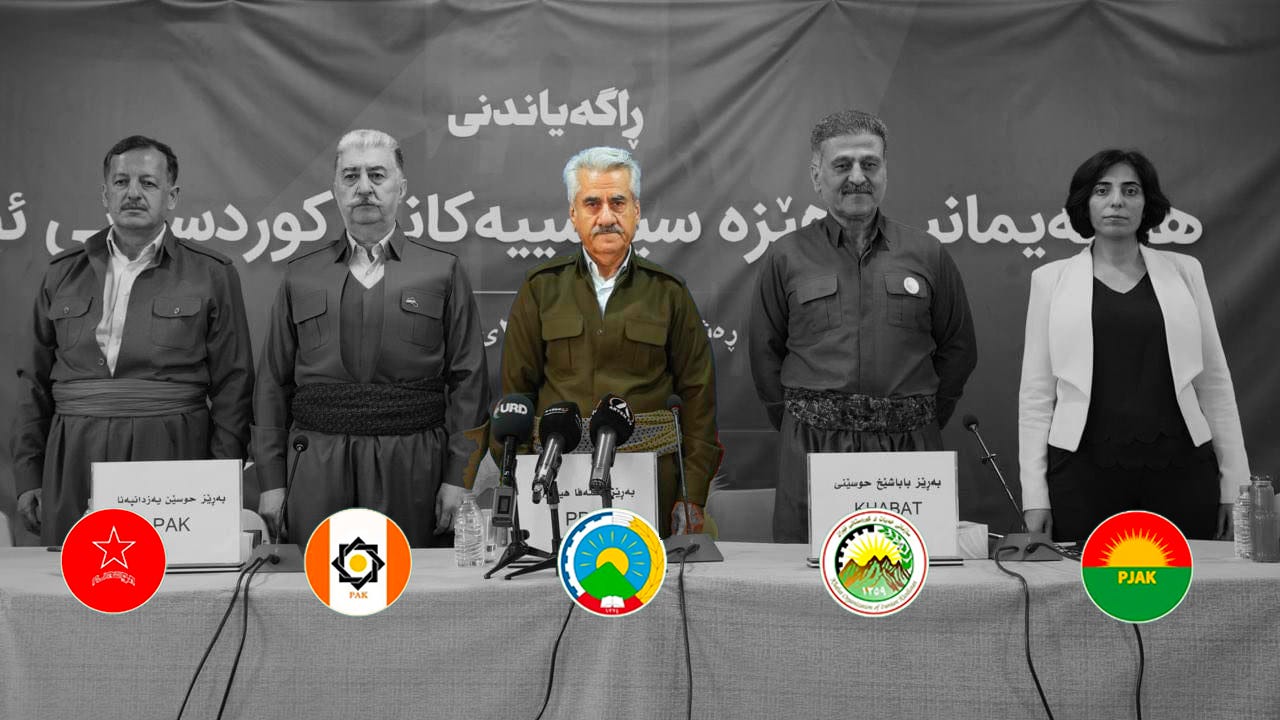
Background on the PDKI
The Democratic Party of Iranian Kurdistan (PDKI) is one of the oldest Kurdish political parties in Iran. It was founded in 1945 in Mahabad, in northwestern Iran, in the context of the emergence of the Republic of Mahabad (1946)—the first modern attempt at Kurdish autonomy in Iran.
Among its major historical figures are Qazi Muhammad, president of the Republic of Mahabad and the party’s first leader, who was executed by the Iranian regime in 1947; and Abdolrahman Ghassemlou, the PDKI’s Secretary-General and a prominent intellectual figure of the Kurdish movement, assassinated in Vienna in 1989 during negotiations with representatives of the Islamic Republic. His successor, Sadegh Sharafkandi, was also assassinated in 1992 in Berlin during the Mykonos restaurant attack, widely attributed to Iranian state agents.
The PDKI defines itself as a social-democratic and federalist party, advocating for the establishment of a democratic, pluralist, and federal Iran that guarantees equal rights among the country’s different nationalities and regions. The party calls for regional political autonomy and the recognition of the political, cultural, and linguistic rights of each people within a democratic Iranian state.
Q: How do you assess the current situation? Do you believe the fall of the Islamic Republic is near? Are we witnessing a genuine historic window?
KP: We are living through an extremely sensitive moment in history—a true historic window. The fall of the Islamic Republic appears to us close, real, and increasingly tangible. This regime has lost the very foundations of its legitimacy. It has also lost the capacity that allows a government to sustain itself by anything other than fear, repression, and violence.
All the crises it has produced over the years are now turning against it. But to understand what is happening, we should not look only at the missiles, drones, or strikes against its installations. We must also look at the streets and at society itself. When part of the population expresses satisfaction at seeing the military bases of its own regime being struck, that says something fundamental: it means the bond between the state and the people has been broken.
Nowhere else would we see a population welcoming the bombing of its own country’s military facilities. If this is happening, it is because the regime has inflicted such a level of violence, humiliation, and oppression on society that it has ultimately lost all moral legitimacy. This means the regime has reached its historical end. It is living through its final moments.
Will it take a few days, a few weeks, or longer? I cannot say with certainty. It depends on the dynamics on the ground. But what we are witnessing is clearly a turning point. And the fall of the Islamic Republic will not affect only Iran—it will also reshape the future of the entire region.
Q: Kurdish parties are often described as the only opposition forces in Iran that possess both deep social roots, long-standing political organization, and military experience. What are your objectives today? Are you considering armed action, or do you prioritize a civil uprising from within the country?
KP: We must begin with a historical observation. For a century, under both the Pahlavi monarchy and the Islamic Republic, authoritarian power in Iran has sought to prevent society from organizing itself. These regimes tried to block the formation of strong political parties, modern institutions, and political forces capable of representing the country’s diverse communities. Their logic has always been to fragment society, to keep it in a state of dependency—as if it needed a shepherd rather than democratic institutions.
We still see echoes of this today in certain political narratives centered around a single providential leader, obedience, and a vertical model of power. Such policies have deeply weakened party politics across the country.
Kurdistan, in this respect, has been an exception. Thanks to more than eighty years of continuous political struggle, resistance, social organization, and collective memory, Kurdistan has managed to preserve a structured political fabric, cohesion, and a clear political vision.
But this does not mean that Kurdish parties are seeking a military solution today. The Kurdish question, like the questions facing other peoples of Iran, is not fundamentally a military one. It is a political issue—one concerning violated rights, denied peoples, suppressed identities, and refused autonomy.
If Kurdish parties took up arms, it was not because they saw militarization as their natural path. It was because successive regimes forced them into self-defense through repression. Khomeini’s call for jihad against Kurdistan forced people to resist.
On August 19, 1979, Ayatollah Ruhollah Khomeini issued a fatwa calling for a “jihad” against Kurdish opposition groups in Iran after negotiations between Kurdish parties and the new Islamic Republic government collapsed. This decision triggered a large-scale military campaign in Iranian Kurdistan, marked by aerial bombardments, sieges of cities, and widespread human rights violations.
The peshmerga forces were formed within a defensive framework, not a logic of conquest.
Even today, our priority is not the military path. Our priority is a popular, revolutionary, and political uprising in which the peoples of Iran take their own destiny into their hands. We hope that this historic moment will see Kurds, Arabs, Baluch, Azeris, Persians, Gilaks, and all others rise together. We hope for a movement emerging from society itself—a movement capable of consigning this brutal regime to the pages of history.
That said, if the Islamic Republic continues attacking Kurdistan, Kurdish parties, and even the families of their members, then people also have the right to defend themselves. But our priority remains clear: political change driven by society itself.
Q: Some observers have raised the possibility of establishing a no-fly zone, similar to what was implemented in Iraqi Kurdistan after 1991. In your view, would such a measure facilitate armed action or shift the balance of power?
KP: We need to recall the sequence of events. In Iraqi Kurdistan in 1991, the no-fly zone did not precede the uprising—it followed it. First, the population rose up. Then Saddam Hussein’s regime attacked and committed massive crimes. It was only after this repression that the UN Security Council adopted a resolution and established the no-fly zone.
In other words, it was not the no-fly zone that produced the uprising. Rather, the uprising and the brutal repression that followed created an international responsibility to act.
Today, we already see people taking to the streets, protesting, and risking their lives. At the same time, we see a regime carrying out large-scale massacres. In such a context, the international community cannot ignore its responsibility. Any measure capable of reducing the regime’s capacity for destruction—preventing its bombings, its missiles, and its drones—can help strengthen society and protect civilians.
That is the core issue: the regime still possesses powerful instruments of destruction, which it uses not only against the peoples of Iran but across the region. These means must be taken away from it. Doing so could create the conditions for a stronger popular mobilization.
Q: Monarchists and supporters of the Pahlavi dynasty are often highly hostile toward Kurdish parties. In this context, is an alliance with other components of the opposition—left-wing groups, republicans, civil associations, organizations representing other ethnic and national communities in Iran, or emerging democratic fronts—possible?
KP: We have never closed the door to dialogue. We have refused discussions with no one. But an alliance cannot be built on empty rhetoric or slogans. It depends on how these groups imagine the future.
The decisive question is simple: do they accept a future in which all the peoples of Iran genuinely participate, on an equal footing, in building the country? Do they clearly recognize the rights of Kurds, Baluch, Arabs, Azeris, Gilaks, Persians, and others? Do they accept the right of peoples to administer their own regions within a shared and democratic framework?
We cannot build unity on denial. We cannot ask people to overthrow a regime if, behind that mobilization, we still refuse to answer what their future will be. One cannot say, “Come and overthrow the Islamic Republic,” while leaving the Kurdish question, the Baluch question, and the broader question of peoples’ rights unresolved.
For years, we have been in contact with left-wing forces, republicans, democrats, and secular groups. Sometimes we have issued joint statements, and at times we have built limited forms of coalition. But many of these groups have remained fragmented. And above all, they have not always had the political courage to say clearly that the Iran of tomorrow must be governed collectively by all its peoples, on an equal basis.
Until that truth is stated explicitly, there will be no solid unity.
Q: Where do you draw your red lines in the event of a large internal and external coalition, possibly supported by Western powers? How can dependence on external actors be avoided, considering past Kurdish experiences often marked by abandonment or betrayal, notably in Iraq in 1975 and more recently in Rojava?
KP: Our position is very clear: the only real guarantee for the future is a democratic and federal system. A system that ensures individual freedoms, human dignity, and the participation of all peoples in shaping the country’s future.
If tomorrow only part of Kurdistan escaped central authority while the rest of Iran remained under an authoritarian regime, that regime would eventually rebuild its power and attack Kurdistan again. History has shown this repeatedly. An authoritarian center does not sustainably respect the rights of peripheral regions; it always seeks to bring them back under control.
That is why our security cannot rely solely on external support. It must rest on the shared participation of all the peoples of Iran in a democratic transformation. The guarantee for the future is that the Baluch are present, that the Arabs of Ahvaz are present, that the Azeris are present, that the Gilaks are present, that the Persians are present—everyone must be part of it. There must be a collective refoundation of the country; otherwise, another form of despotism will eventually return.
Q: Some fear that after the fall of the regime, Iran could descend into civil war or a prolonged conflict between different peoples and political groups. How can such a scenario be avoided?
KP: First, by rejecting the idea that military force can serve as a general solution. Weapons cannot resolve political problems, questions of rights, or conflicts between peoples. If military violence were enough to erase such problems, then Reza Shah, Khomeini, or Khamenei would already have “solved” them through force. They have massacred, bombed, and repressed—and yet they resolved nothing.
The only serious path forward is dialogue: political negotiations, clear agreements, and mutual recognition. There must be genuine equality of rights, equality of identities, and respect for human dignity. We must build a future in which no group seeks to eliminate another.
We advocate for a democratic and federal system—not a competition between groups to control territory or exclude others. Ethnic and regional tensions have often been fueled by the divide-and-rule policies of authoritarian power. We must move beyond that logic and replace it with a politics of cooperation.
Q: If the regime falls, what would happen to the weapons held by Kurdish parties? Would the peshmerga forces be dissolved, centralized, or maintained within a federal framework?
KP: Here again, we must return to the original purpose of these forces. The peshmergas were formed to defend the Kurdish population against repression, military campaigns, calls for jihad, and the risk of massacres or even genocide.
In a democratic and federal Iran—one with clear laws and equal rights for all nationalities—the peshmergas could become one of the recognized security structures within a legal framework. In different regions, local forces could exist to ensure security under a common, transparent law adopted through democratic institutions and serving the entire population.
However, if a new authoritarian power were to emerge, trample once again on the promises made, or launch another war against Kurdistan, people would defend themselves. The only way to prevent the issue of arms from returning is to guarantee rights in a real and lasting way.
Q: In this context of war, how do you perceive international reactions and positions regarding violence and civilian casualties?
KP: Every human life lost in this war is a tragedy. But the primary responsibility lies with the Supreme Leader and the policies he has pursued for years—policies of repression, chaos, regional escalation, and constant confrontation. Every drop of blood shed today is also the result of that political trajectory.
What strikes me in some international reactions is their selectivity. Violence and civilian casualties should be condemned consistently, regardless of who is responsible. Yet we sometimes see outrage that is highly selective: some strongly condemn the deaths occurring today while having remained silent about the crimes and massacres committed by the Islamic Republic against its own population, including as recently as last January.
Q: Finally, what message would you like to send to Iranians inside the country, to Kurds across the four parts of Kurdistan, and to the diaspora?
KP: Our message is the same for everyone. The Pahlavi regimes and the Islamic Republic have shown us the consequences of fascism, authoritarianism, and intolerance.
If we want a better future for our children, we must learn to respect one another’s rights. We must abandon the erasure of the other, the illusions of domination, authoritarian myths, and the obsession with a past used to deny the present.
The future can only be built collectively, on the basis of equality. Only in that way can another Iran be born.
Biographical note
Karim Parwizi is a senior member of the Democratic Party of Iranian Kurdistan (PDKI). Born in 1977 in Kamyaran, in Iran’s Kurdistan Province, he joined the party’s organization in 1999 after completing studies in computer engineering in Tehran. In 2001, he joined the ranks of the PDKI peshmerga forces. Over the years, he has held several responsibilities within the party, including roles in the Press Commission, the Students’ Union, and the Supervisory Commission. In 2004, he became an advisor to the party’s Central Committee, and in 2008 he was elected member of the Political Bureau of the PDKI.